Judo Belt Progression: What Your Child Will Learn at Each Level
One of the first things parents ask when their child starts judo is: “How long does it take to get a black belt?” It’s a fair question: the belt is visible, tangible, and easy to understand. But for kids who train at Ishikawa Judo Club in Burnaby, the belts are just markers along a much longer journey. The real story is what children learn at each step along the way.
How the Judo Belt System Works in Canada
Judo Canada uses a graded ranking system divided into two main stages: kyu grades for beginners and intermediate students, and dan grades for advanced and black belt practitioners.
For junior students (typically under 14), the belt colours progress through a sequence designed to build skills and confidence gradually. Many clubs also use half belts (belts with a horizontal stripe of the next colour sewn across one end) as an intermediate step between full ranks. These give younger students a more frequent sense of progress, which can make a real difference in motivation over the months and years of training. The exact colours can vary slightly by club and province, but most Canadian clubs following Judo Canada’s curriculum use a progression that runs from white through yellow, orange, green, blue, and brown before reaching black.
Adult beginners follow a similar path with fewer intermediate colours, moving from white through yellow, orange, green, blue, and brown before earning a black belt (called Shodan, or first dan).
There is no shortcut and no set timeline. Some children progress through a belt in a few months. Others take longer. Both outcomes are perfectly normal, and Ishikawa’s senseis encourage students to focus on mastery rather than speed.
What Children Actually Learn Belt by Belt
White Belt: Where Every Judoka Begins
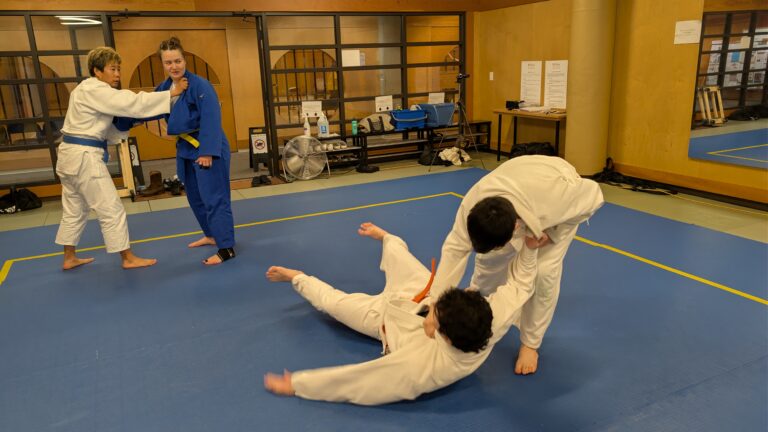
White is the starting point for every student, from age five to adult. At this stage, children learn how to fall safely (ukemi), how to bow correctly when entering and leaving the mat, and the basic rules of the dojo. White belt teaches respect and listening before anything else.
For younger children in the Family Judo program, white belt is where parents train alongside their kids. It is a playful, foundational stage, all about building comfort on the mat and learning to trust the process.
Yellow and Orange Belt: The Fundamentals Take Shape
As students earn their first coloured belts, they begin learning the core throws and grappling techniques that form the backbone of judo. Hip throws, shoulder throws, foot sweeps, and basic groundwork all start here.
This stage is where children begin to understand that judo is not just about strength. Balance, timing, and reading a partner’s movement matter far more than size. Smaller kids often discover, sometimes to their own surprise, that they can throw a bigger partner when the technique is right.
Green and Blue Belt: Refining the Craft
By green and blue belt, students have a working foundation and begin putting techniques together more fluidly. Combinations become important. A student might set up a shoulder throw with a foot sweep, or transition between standing techniques and groundwork.
At this stage, children in Ishikawa’s Junior Judo program often start to develop a sense of their own style. Some favour fast, footwork-heavy judo. Others are drawn to powerful hip throws. Senseis work with each student’s natural tendencies rather than forcing a single template.
Children at this level also begin to understand shiai (competitive judo) if they are interested in tournaments, though competition is never mandatory at Ishikawa. Many students enjoy judo purely for the training and community.
Brown Belt: The Edge of Mastery
Brown belt is the final stage before black, and it is where everything comes together. It is also the highest belt that Ishikawa Judo Club awards directly. Before recommending a student for brown belt, the senseis look for more than technical ability. They want to see that the student genuinely embodies the values of judo: respect for their training partners, humility for any outcome, and the perseverance to keep showing up. A brown belt at Ishikawa is not just a sign of skill. It is a reflection of character.
It is worth noting that many brown belts train for a year or more before being ready for a black belt grading. This is by design. Judo does not rush its practitioners to the top rank.
Black Belt: A Beginning, Not an Ending
In judo, black belt (Shodan) is not the finish line. It means a student has mastered the fundamentals well enough to begin serious study. Black belt grading in Canada is administered not by individual clubs, but by the Judo Canada Grading Committee. A student must be recommended by their club and meet specific requirements before they can be considered. It is a process that reflects the seriousness with which judo treats this rank. In Japan, the word for black belt holder is “yudansha,” literally “one who has a rank.” It signals readiness to go deeper, not arrival at the top.
The early belts were about learning. Black belt is where real understanding begins.
What the Belt System Teaches Beyond Judo
Parents at Ishikawa often notice something that goes well beyond technique: their children become more patient. Judo’s belt system teaches children to work toward something that cannot be rushed or bought or taken as a shortcut. Each rank is earned through consistent effort over real time.
The values of judo (respect, humility, perseverance) are not separate from the belt system. They are built into it. A child who earns a blue belt has not just learned six throws. They have shown up, again and again, and kept working even when progress felt slow.
That is a skill that carries well beyond the dojo.
Ishikawa Judo Club offers programs for children from age five through adult in Burnaby, BC. To learn more about our programs and current availability, visit our Programs page. Interested in joining? Get in touch or join the waitlist here.